Flower Character Writing Tutorial Animation
Tutorial 2D Animation 2026-08-20
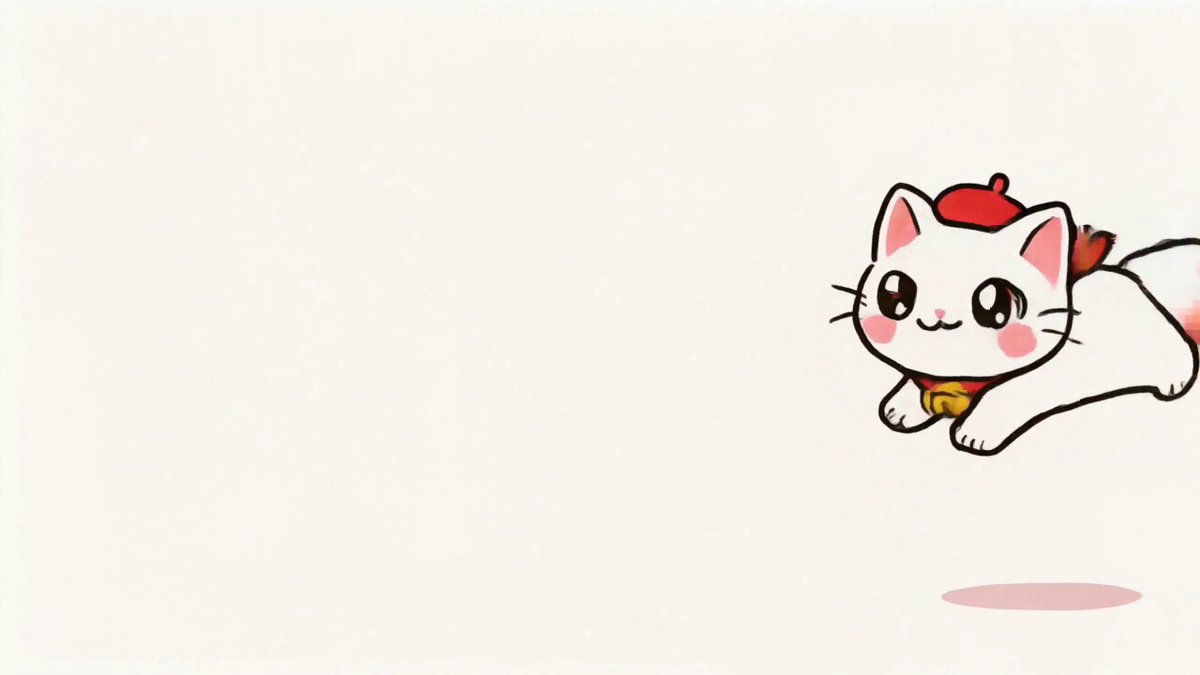
Footage © @tanabe_fragm · View original post
The clip was published publicly by its creator and is linked here directly; rights holders may request removal.
Full prompt
おちゃばなしさん(@tea_story_hoshi)からヒントを頂き、MiniMax H3で漢字の書き順が学べる動画を生成。

私のプロンプトの問題なのか、同じくMiniMax H3で作った掛け算学習動画(引用元)と比べると、ちょっとクオリティが落ちる感が……😅
漢字だとリズムを作りにくいせいでしょうか...

それでも、子供にとって面白味を感じにくい漢字の書き順を、すこしだけ楽しく学べるかなと思います😃

動画はMiniMax H3のT2V(テキストから動画)で生成しました。
プロンプトはこちら↓
---------------
integrated_multimodal_description:
2D-animated, a bright and playful children's cartoon in 16:9 with exactly 5 shots at 24fps,
in the style of a cheerful Japanese picture book: thick soft outlines, flat cel shading, light
paper grain, no gradients, no photorealism, no 3D rendering. Palette: cream white background,
soft black lines, cherry-blossom pink, fresh grass green.

The character is Hana-chan, one round-faced white kitten with big sparkling black eyes, pink
blushed cheeks, a small pink nose, an orange tail tip, a small red scarf with a golden bell,
and a tiny red beret. She holds an oversized red calligraphy brush like a conductor's baton
and waves it to make each stroke appear from a distance; she never walks into the writing
grid. She is expressive and comedic at all times: her ears pop up, her tail wags in rhythm,
her cheeks puff, she stands on her hind legs, and she counts on her paw pads. Small cartoon
effect marks appear around her — sparkle stars when she is proud, a tiny sweat drop when she
concentrates, floating music notes when she dances, and a small exclamation mark when she is
surprised. Preserve her exact face, shape, beret, scarf, bell and colors throughout; never
redesign her.

The film teaches how to write one Japanese kanji: "花", which means flower and has exactly
seven strokes, no more and no less. A large square writing grid with thin grey guide lines
sits in the left two thirds of the frame and never moves. Hana-chan always stays in the right
third and never covers the grid. The camera never moves for the whole 15 seconds.

Each stroke is drawn one at a time inside the grid, in the order listed below, as a single
continuous line growing from its starting point to its ending point. The stroke being drawn
is cherry-blossom pink; once the next stroke begins, the previous one turns soft black and
stays black. A small pink number appears beside each stroke as it is drawn, counting up
strictly in order, 1 then 2 then 3 then 4 then 5 then 6 then 7, never repeating a number and
never skipping one.

The seven strokes of "花", in order:
1. a horizontal line across the upper third of the grid, drawn from left to right.
2. a short vertical line in the upper-left area, drawn downward, starting above the
   horizontal line and crossing through it.
3. a short vertical line in the upper-right area, drawn downward, starting above the
   horizontal line and crossing through it. Strokes 1 to 3 form the grass radical on top.
4. a sweeping stroke in the lower-left area, drawn from upper right to lower left.
5. a straight vertical line in the lower-left area, drawn downward to the bottom of the grid.
6. a short sweeping stroke in the lower-right area, drawn from upper right to lower left.
7. a long vertical line in the lower-middle area, drawn downward, then turning right along the
   bottom and hooking upward at the end.

[Shot 1] Static shot of a bright cream-colored room with soft paper texture. Hana-chan
cartwheels in from the right edge and lands on her hind legs with a bounce, then the empty
writing grid pops into the left two thirds with a springy squash-and-stretch, then she spins
her big red brush once and points it at the grid with a wide excited grin, sparkle stars
popping around her head.

[Shot 2] At 00:02.000, the shot continues from the identical camera position and framing.
Stroke 1 is drawn at 00:02.000, stroke 2 at 00:03.500 and stroke 3 at 00:05.000, each in pink
with its number beside it, each turning black as the next begins. Hana-chan swings her brush
in a wide arc for each stroke, hops and lands with her ears flapping, and after the third
stroke she holds up her paw pads showing three counted toes with a proud puffed chest.

[Shot 3] At 00:06.500, the shot continues from the identical camera position and framing.
Stroke 4 is drawn at 00:06.500, stroke 5 at 00:07.600, stroke 6 at 00:08.750 and stroke 7 at
00:09.875, each in pink with its number beside it. Hana-chan narrows her eyes in comic
concentration with a tiny sweat drop, bites her lip, flicks the brush sharply for each stroke,
and her tail whips faster and faster as the strokes go on.

[Shot 4] At 00:11.000, the shot continues from the identical camera position and framing. All
seven strokes are now soft black and the completed kanji "花" fills the grid. The numbers fade
away, a soft pink glow bursts behind the character, and Hana-chan throws her brush in the air,
does a full spin on her hind legs, and lands in a triumphant pose with both paws up, eyes
turned into sparkling stars and music notes floating around her.

[Shot 5] At 00:13.000, the shot continues from the identical camera position and framing. The
completed kanji "花" stays in the grid, the hiragana reading "はな" appears in small black type
directly beneath the grid, and cherry-blossom petals shower down through the frame while
Hana-chan catches one petal on her nose, goes cross-eyed at it, giggles, and finishes with a
happy bow. Hold until exactly 15.000 seconds.

Overall: the camera is locked off for all 15 seconds with no pan, no zoom and no shake. The
writing grid stays in exactly the same position in every shot and Hana-chan never overlaps it.
Strokes are only ever added, never erased, never redrawn and never reordered, and the finished
character must be exactly "花" with exactly seven strokes. Keep her animation lively and
bouncy at every moment; she is never still. No other kanji, no other letters, no numbers
except the stroke counters 1 to 7, no chalkboard, no subtitles, no captions and no watermark.

overall_soundscape:
Each stroke starts with a crisp wooden click and finishes with a swishing brush sweep across
paper. Hana-chan's hops land with springy boings, her golden bell jingles when she spins, and
soft paw taps patter on the wooden floor between strokes. Bright sparkle chimes ring when she
strikes a proud pose, a small pop accompanies her puffed cheeks, and a party-popper burst,
warm applause and a shower of rustling petals fill the ending. Playful kitten mews and happy
squeaks throughout, but no spoken words.

non_diegetic_music:
An original 15-second upbeat children's tune at a fast, bouncy tempo around 128 beats per
minute, built from marimba, toy piano, ukulele, glockenspiel, tambourine, hand claps and a
cheerful whistled melody over a walking bass. Each of the seven strokes lands on one note of a
rising major scale, climbing one step higher per stroke, so the melody rises steadily from the
first stroke to the seventh. Resolve onto the octave above with a short bright fanfare and a
cymbal roll at 00:11.000, then finish on a warm sparkling chord at 15.000 seconds.
Details
| Target model | MiniMax H3 |
|---|---|
| Use case | Tutorial |
| Style | 2D Animation |
| Media | Video |
| Duration | 15.1s |
| Aspect ratio | 16:9 |
| Likes | 11 |
| Published | 2026-08-20 |
Attribution
Author: @tanabe_fragm · View original post
Prompts remain the copyright of their authors. We index and quote them with attribution plus a link to the original post; rights holders may request removal.
Run this prompt through the API
Copy the prompt above into a MiniMax H3 (Hailuo) text-to-video call to reproduce the shot. When adapting it, swap subject, setting and camera move one clause at a time. Access and licensing details are on About.