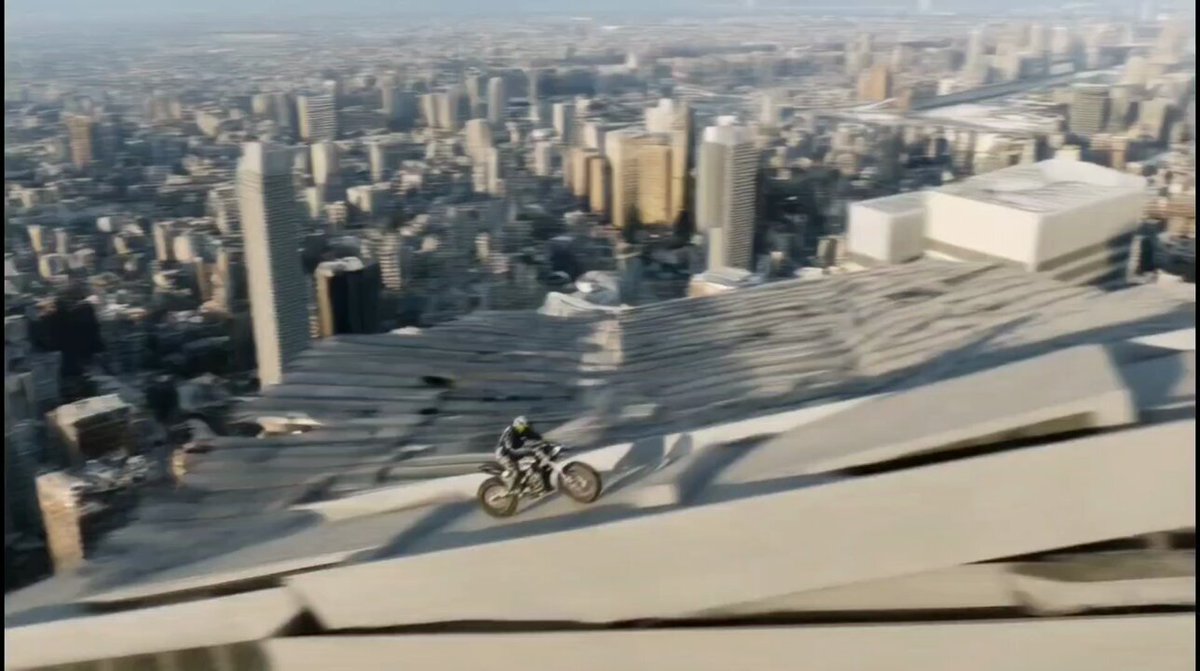
In one sentence: How can a pure text-to-video prompt under 50 words carry a 10-second high-speed aerial parkour shot? For those who want to trade minimal length for intense dynamic footage without stacking adjectives.
Field Table
| Field | Value |
|---|---|
| model | Hailuo 2.3 (per: author’s original post body self-labels “with Hailuo 2.3”; not verified by this library) |
| duration | 10.2 seconds |
| aspect | 120:67 |
| seed & reproducibility | Not recorded; unverified — author has published the final video; this library has not re-run it |
| final video link | Embedded preview on page; see card above and original post |
| estimated cost | To be estimated (per official pricing, use cost calculator) |
| author & original link | @umesh_ai · https://x.com/umesh_ai/status/1981931234797535433 |
prompt_en
Reprinted verbatim (attribution + original link complete, see field table):
From a soaring aerial, the rider rockets across a collapsing skyline, rooftops narrowing into jagged ledges. Camera hovers tight above as he angles through curved glass and steel, void yawning between buildings. Each rooftop leap sparks drama, until he threads impossibly across the final span, city blurring below.
prompt_zh
Self-translated by this library; a variant, not generation-tested, marked unverified:
High-altitude aerial view opens in, the rider hugs a collapsing skyline as he rockets past, rooftops gradually narrowing into jagged ledges. The camera hovers tight above his head, following as he shifts angles between curved glass and steel structures, bottomless gaps yawning open between buildings. Each rooftop leap sends a wave of tension, until he threads impossibly across the final span, the city below streaking into a blurred afterimage.Breakdown
The 4 Things It Gets Right
1. The first sentence binds “camera position” and “subject motion” together in one go. “From a soaring aerial, the rider rockets across a collapsing skyline” — one sentence delivers three pieces of information at once: the camera is at altitude (soaring aerial), the subject is moving laterally at speed (rockets across), and their relative relationship is a top-down follow. Many people write aerial shots in two sentences — first saying “drone high-angle shot” then “a person running” — leaving the model with two parallel descriptions and forcing it to guess who is following whom. Here, the grammatical structure itself is “from A’s perspective, watch B do C,” so the relationship is locked in by sentence structure, not left to the model’s inference.
2. “Camera hovers tight above” conveys altitude, distance, and follow mode with a single verb phrase. Hover means the camera stays relatively static relative to the subject (not sweeping past laterally); tight gives the distance (close-up, not a wide establishing shot); above gives the angle (top-down). Three words replace an entire string of parameterized descriptions. Compare the common phrasing “drone shot, following the subject from above, close distance” — the information load is the same, but that version is three parallel tags, whereas this is a verb phrase with state, making it far easier for the model to parse as one continuous action rather than three static attributes.
3. All adjectives describe ongoing change, not static appearance. Collapsing, narrowing, yawning, blurring — all four key modifiers are present participles. This isn’t a stylistic flourish; it’s an information problem. Video models need “what changed from this frame to the next.” Static adjectives (tall buildings, glass towers) only describe a single frame, while participle forms inherently carry a timeline. This prompt has almost no purely cosmetic adjectives — all its density goes to motion.
4. Negative space creates danger instead of saying “danger” outright. “void yawning between buildings” — writing the gaps between buildings as an actively opening abyss gives depth (the audience knows how high up this is), adds emotional weight, and incidentally defines the physical conditions for the jump action. This is far more useful than writing “dangerous jump, high risk,” because the latter is an abstract judgment — the model can’t render “danger” into pixels — whereas “a void opening between buildings” is directly imageable.
Where It Could Improve
1. No upfront technical declaration at all. Duration, aspect ratio, frame rate, and lens focal length are all absent. This clip’s 10.2 seconds and 120:67 aspect are results of platform defaults or interface settings, not the prompt. When writing your own, put these in an opening line (e.g., ”10s, 21:9, 24fps, wide-angle aerial”) to save a re-run round; especially for high-speed motion subjects, whether you specify frame rate noticeably affects motion blur perception.
2. The subject is only “the rider” — three words — so multi-generation runs will inevitably drift. No lock on clothing, build, gear, or hairstyle. A single 10-second clip is fine, but the moment you plan a second or third shot, the rider will become a different person. Even adding one clause like “a lean rider in a black hooded jacket and red gloves” would drastically lower consistency cost. Also, “rider” itself is ambiguous (horseback rider? cyclist? — here it’s actually a parkour practitioner); swapping in the more explicit traceur / free-runner or just describing the action directly would be more stable.
3. “sparks drama” and “impossibly” are evaluative words that take up space without landing. Drama and impossibly describe the audience’s feeling, not the visual content. In a prompt of only 48 words, these two spots are nearly the only waste. They could be replaced with concrete actions — for instance, rewrite “Each rooftop leap sparks drama” to specify the takeoff and landing mechanics (debris scattering, landing roll, hand gripping the edge), and rewrite “threads impossibly” to specify how wide that final span is and how he gets across. Same word count, but imageable information in exchange.
Further Reading
- “Video Prompt Basic Structure: Five Elements”
- “Camera Movement Command Glossary v0 (Bilingual)”
- “How to Write Aspect Ratio / Frame Rate / Duration Front Declarations”