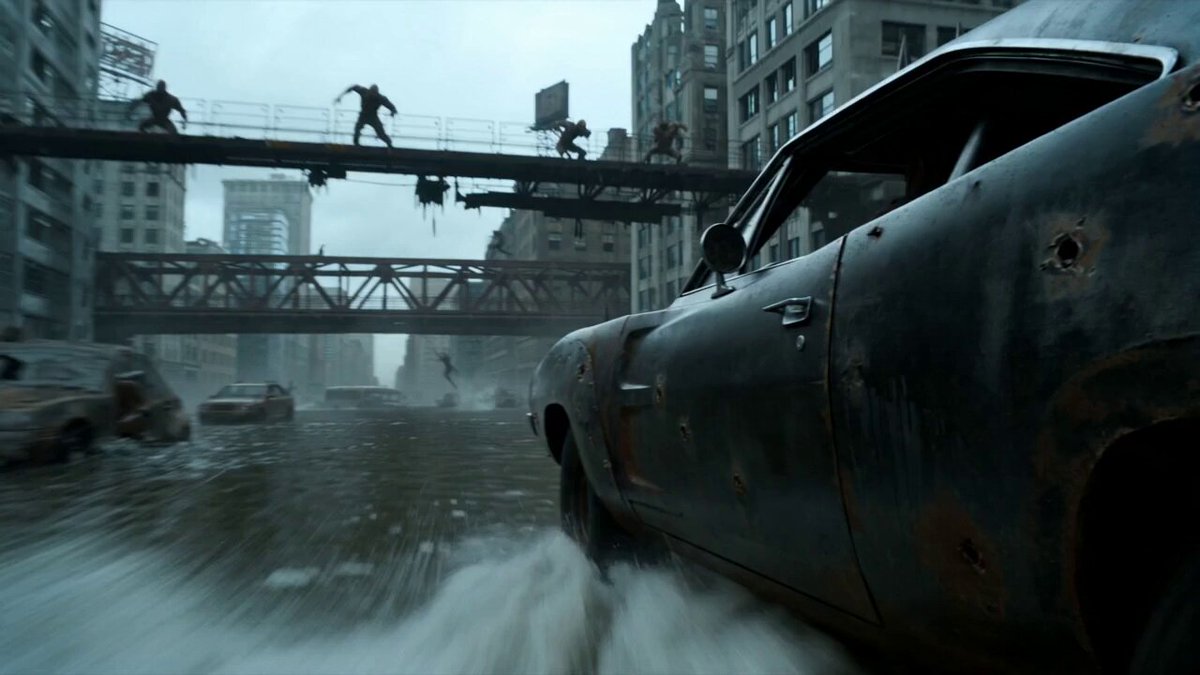
This breakdown examines a real, widely circulated 15-second car chase prompt: it splits time into three segments, each assigned one key action—the most basic yet effective form of a “storyboard-level long prompt.” Suitable for those who want to write multi-action continuous shots but often find models dropping actions.
Field Table
| Field | Value |
|---|---|
| model | Hailuo (author noted Made in Hailuo) |
| duration | 15 seconds |
| aspect | 16:9 (based on actual output aspect ratio) |
| seed and reproducibility | Not recorded; unverified—author claims it was generated, this library has not re-run it |
| Output link | Output 15.1s · 16:9, embedded preview on page, see card above and original post |
| Estimated cost | To be estimated (official unit price × 15 seconds, use cost calculator) |
| Author and original link | @CharaspowerAI · https://x.com/CharaspowerAI/status/2077045476528939384 |
Output comparison: The original post’s output runs 15.1 seconds, perfectly matching the 15-second timeline declared in the prompt—this is the most direct evidence for judging whether a prompt truly executes by segments. When watching, focus on comparing whether the three segment transition points (4s, 10s) align with the text description.
prompt_en
Reprinted verbatim (attribution + original link complete, see field table):
A desperate survivor driving a reinforced muscle car covered in spikes and bullet holes 0–4s: speeds through a flooded ruined city while infected creatures chase across rooftops and bridges; 4–10s: drifts through flooded streets, smashes through barricades, dodges collapsing buildings and hits nitro as waves crash around him; 10–15s: bursts through a wall of water onto dry ground while the infected fall behind into the flood, ending with the car stopping at sunrise overlooking the dead city Cinematic post-apo car chase, water VFX, low tracking, FPV-style speed, debris, heroic final reveal.
Chinese template
Self-translated by this library, a variant; the Chinese version has not been generation-tested and is marked unverified:
A desperate survivor drives a reinforced muscle car welded with spikes and riddled with bullet holes
0–4s: speeds through a flooded ruined city while infected creatures chase across rooftops and bridges;
4–10s: drifts through flooded streets, smashes through barricades, dodges collapsing buildings, and hits nitro as waves crash around him;
10–15s: bursts through a wall of water onto dry ground, leaving the infected falling behind into the flood, ending with the car stopping at sunrise overlooking the dead city
Cinematic post-apocalyptic car chase, water VFX, low tracking, FPV-style speed, flying debris, heroic final reveal.
Breakdown
Four Things It Does Right
- Subject defined upfront and stated only once—the first line locks down the car and person (spikes, bullet holes); the following three segments only describe actions without re-describing the car. This is the standard practice for preventing character drift.
- Time segmented, one focus per segment—0–4s sets up the chase, 4–10s is the action climax, 10–15s is the escape and resolution. Segment durations increase (4/6/5 seconds), giving the climax the longest stretch.
- Style tags concentrated in the final line—camera work, VFX, and texture are all packed into the last sentence, not mixed into narrative segments. Narrative stays narrative, style stays style—models are less likely to blend things together.
- Clear final frame provided—“stopping at sunrise overlooking the dead city” gives an endpoint image rather than letting the action cut off abruptly.
Three Areas for Improvement (avoid these when writing your own version)
- Action density overload: About 10 actions are packed into 15 seconds (speeding, drifting, smashing through, dodging, igniting, bursting through, stopping…). Most models cannot reliably execute such density; in practice, the middle ones often get dropped. To stay stable, cut each segment down to 1–2 actions.
- Camera work not assigned per segment:
low trackingandFPV-styleonly appear in the final tags, leaving the model to decide which segment uses what camera angle. Per this library’s “Storyboard-Level Long Prompts” guidance, it should be specified segment by segment—e.g., 0–4s low tracking shot, 10–15s pull back for the ending. - Missing format declaration: No aspect ratio or frame rate specified, leaving the model to improvise. See “Declaring Aspect Ratio / Frame Rate / Duration Upfront.”
Further Reading
- “Storyboard-Level Long Prompts: Organizing by Timeline Segments”
- “Basic Video Prompt Structure: Five Elements”
- “Declaring Aspect Ratio / Frame Rate / Duration Upfront”