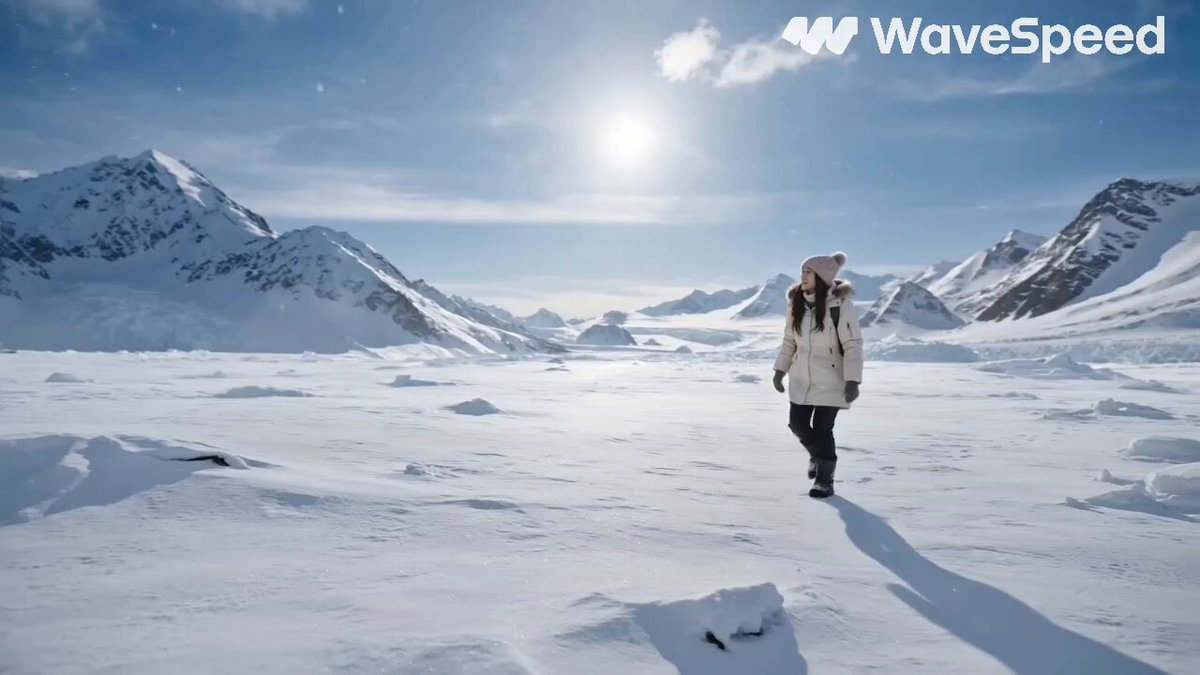
One-liner: A 14.5-second polar documentary prompt that puts all three of this library’s rules (centralized format declaration, character consistency locking, negative list) to use, making it a good reference sample for rule-by-rule verification; it also exposes the typical flaw of “parameters fully specified but camera work not written out.”
Field Table
| Field | Value |
|---|---|
| model | Seedance 2.5 (Basis: author’s original post states it was generated on wavespeed.ai; not verified by this library) |
| duration | 14.5 seconds (prompt states Duration: 14s) |
| aspect | 16:9 |
| seed and reproducibility | Not recorded; not verified — the author has released the final video, this library has not re-run it |
| final video link | Embedded preview on page, see card above and original post |
| estimated cost | To be estimated (per official pricing, using cost calculator) |
| author and original link | @ayzalnooor24521 · https://x.com/ayzalnooor24521/status/2090654913927983477 |
prompt_en
Verbatim reproduction (attribution + original link included, see field table):
A cheerful young woman explores a vast snow-covered Arctic landscape wearing a warm padded coat, knitted cap, gloves, winter pants, and closed snow boots. She walks through deep snow, amazed by the breathtaking mountains and falling snow. She discovers a polar bear cub and penguins nearby and happily watches them. She takes beautiful photos of the animals with her camera. She laughs and plays gently in the fresh snow while the animals move naturally around her. She sits in the snow, smiling joyfully as the polar bear cub and penguins remain nearby; camera slowly pulls back to reveal the vast snowy landscape. Duration: 14s | 16:9 Landscape | Style: Ultra-realistic cinematic travel documentary, photorealistic 4K HDR, natural winter daylight Maintain the same woman, face, outfit, and appearance throughout. Realistic animal behavior, natural movement, detailed snow and fur, smooth cinematic transitions, immersive winter ambience, no text, no subtitles, no logos, no watermark, no animation.
prompt_zh
Self-translated by this library, a variant, not generation-tested, marked unverified:
A cheerful young woman explores the vast Arctic snowfield, wearing a warm padded jacket, knitted cap, gloves, winter pants, and closed snow boots. She walks through deep snow, marveling at the majestic mountains and falling snowflakes. She spots a polar bear cub and a few penguins nearby and watches them happily. She takes beautiful photos of the animals with her camera. She laughs and plays gently in the fresh snow while the animals move naturally around her. She sits in the snow, smiling joyfully, with the polar bear cub and penguins still nearby; the camera slowly pulls back to reveal the vast snowfield panorama.
Duration: 14s | 16:9 Landscape | Style: Ultra-realistic cinematic travel documentary, photorealistic 4K HDR, natural winter daylight
Maintain the same woman, face, outfit, and overall appearance throughout. Realistic animal behavior, natural movement, detailed snow and fur, smooth cinematic transitions, immersive winter ambience, no text, no subtitles, no logos, no watermark, no animation.
Breakdown
The 4 Things It Got Right
1. Format parameters on their own line, separated from the narrative
After the main action text, a separate line reads: Duration: 14s | 16:9 Landscape | Style: Ultra-realistic cinematic travel documentary, photorealistic 4K HDR, natural winter daylight. The three parameter groups are separated by pipes, with not a single action word mixed in. The practical benefit is that parameters won’t be parsed as visual content — if you folded them into a sentence like “a 16:9 cinematic 4K shot of a woman…”, those words would compete with the subject description for attention weight. This library’s “Centralized Declaration of Aspect Ratio / Frame Rate / Duration” advocates exactly this kind of centralized declaration; this prompt places the declaration after the main text rather than before — different position, same isolation effect.
2. Consistency locking sentence split across four dimensions, with lockable content preceding it
Maintain the same woman, face, outfit, and appearance throughout — not a vague “same character,” but an explicit enumeration of person, face, outfit, and overall appearance. More critically, the first sentence lists the outfit item by item: a warm padded coat, knitted cap, gloves, winter pants, and closed snow boots — five full pieces. The locking sentence itself doesn’t generate an appearance; it only demands “don’t change.” What actually determines what doesn’t change is the list before it. Writing only a locking sentence without a list is like asking the model to guard an appearance it improvised on the spot.
3. Negative list has only 6 items, all of the same type
no text, no subtitles, no logos, no watermark, no animation. The first four are really four manifestations of one thing: no overlaid graphic elements on screen. The fifth, no animation, reinforces the style and pairs with the opening Ultra-realistic / photorealistic as a positive and negative statement. The list stays clean because it doesn’t mix in generalized negations like “no blur” or “no deformed fingers” — those kinds of words often just inject the concepts of “blur” and “deformity” into the context. See “Negative List (AVOID Section) Writing”: short, same-type, verifiable — this one basically follows that template.
4. Camera movement given only once, at the moment it’s needed
Six actions flow naturally in time: walking → marveling → discovering → photographing → playing in snow → sitting. The only camera instruction in the entire prompt hangs after a semicolon in the final sentence: camera slowly pulls back to reveal the vast snowy landscape. The key is to reveal — the pull-back isn’t movement for its own sake; it carries a narrative task: the subject is seated, the action has wound down, and now the frame widens, shifting information from “person and animals” to “how small the person is in the snowfield.” A camera instruction with motivation is more likely to be executed as intended than a bare “pull back.”
Its Areas for Improvement
1. Camera work and parameters both only half done
The full video is 14.5 seconds, yet only the final moment has camera direction. The photographing and snow-playing segments take up most of the runtime, with shot size and movement entirely left to the model’s discretion — it might stay in a fixed medium shot throughout, or it might cut on its own. To regain control, the main text should be split into a timeline with a camera note per segment: 0–4s medium shot following the walk, 4–8s over-the-shoulder looking at the animals, 8–11s close-up of hands and camera, 11–14.5s pull-back wide shot. Similarly, the declaration line has Duration and aspect but is missing fps; whether the documentary style defaults to 24 or 30 makes a noticeable difference in motion texture, and that shouldn’t be left to chance. Also note the prompt says Duration: 14s while the final video is 14.5 seconds — the duration in the main text is closer to a wish; what actually takes effect is the platform-side duration setting. For precision, set it in the generation parameters.
2. The subject is the vaguest part of the entire prompt
A cheerful young woman — age range, hair color and style, skin tone, face shape, glasses or not: none are specified. So the locking sentence praised above has no anchor to lock onto here: whatever face the model generates in the first frame is what it holds for the rest, and what face it generates in the first frame is random. Five pieces of clothing are specified, but the person gets only two adjectives — the level of detail is inverted. When writing your own, add at least three attributes to the subject, and choose features that don’t change with pose (hair color, face shape, skin tone). Don’t treat expression words like cheerful as identity traits — expressions are supposed to follow the story anyway.
3. Ecological flaw: polar bears and penguins don’t share a habitat
Polar bears live in the Arctic; penguins live in the Antarctic. The first sentence already explicitly states Arctic landscape, yet penguins appear nearby later. The model won’t correct this — it will just comply. The problem is that the style declaration is travel documentary plus photorealistic: the more documentary-like it is, the more glaring this factual error becomes. This isn’t the model’s fault; it’s the prompt digging its own hole: the style positioning and content setting undermine each other. If the style were changed to fantasy or a fairy-tale picture book, the same content would be self-consistent; since a documentary was chosen, the factual constraints of a documentary must be respected.
Further Reading
- “Centralized Declaration of Aspect Ratio / Frame Rate / Duration”
- “Character Consistency Locking”
- “Negative List (AVOID Section) Writing”